The Artist Who Returns: Why Repeating an Idea in Your Art Can Lead to Stronger Investigation and Inquiry
Updated: Sep 4
How Repetition Helps You Go Deeper Into Your Work

There is a moment in creative practice when you realise you've been circling the same idea for months, or even years, without being fully conscious of it.
A motif might keep appearing, a question keeps surfacing. A feeling finds its way into your imagery again and again, though slightly differently each time, as if the work itself is trying to tell you something you haven't yet been able to register.
In the early days of establishing a creative practice, it can be easy to mistake this repetition for a lack of imagination or worst of all - a creative rut, evidence that you've run out of ideas or that you've simply entered production mode with an idea that works for you.
But I've been contemplating this as I've worked my way through the Threshold Series, which now numbers 26 paintings (which is a lot for me in one series). And I've found my way to a different interpretation of this idea of repetition of particular motifs.
Returning to an idea, really returning to it, with curiosity and without apology, might be the most important and courageous thing you can do as an artist.
| More Than Making the Same Painting
But what do I mean by 'repetition' in this context?
I don't mean painting the same piece again in a different colour palette.
What I mean is this: returning to an idea because you haven't finished with it. Because it hasn't fully resolved itself yet, and some part of you knows there's more there to understand.
It's about:
there being something more to explore within the same parameters - this could be compositional, for example, or conceptual or material;
the visual, theoretical or conceptual question you asked in the first painting may not be fully answered yet;
feeling like you can't willingly let go of the idea or the imagery yet;
repeating the imagery until you recognise a new, deeper line of inquiry.
This is repetition as excavation. As investigation.
It's the slow, patient work of an artist who has become concerned with finding the very essence of an idea. And this essence can be found as a consequence of repeatedly making the same thing over and over again, in order to refine it and see it with a greater clarity each time.
| The Artists Who Returned
There are many famous artists who understood this instinctively, who spent their entire careers circling the same territory, going deeper with every return.

Claude Monet (1840–1926)
Monet painted haystacks more than thirty times between 1890 and 1891. Not because he had run out of subjects, but because he realised that what he was really painting was not haystacks at all. He was painting light and time. The way a single ordinary thing could look completely different depending on the time of day and the season.
Each canvas was not a repetition of the last, it was a new question asked of the same subject.
The Rouen Cathedral series followed the same logic with more than thirty paintings of a single facade, each one revealing something different from the others.

The Water Lilies, which occupied the last decades of his life, took this further still; the same pond, the same reflections, an almost infinite investigation into what water and light and surface could hold. Monet painted roughly 250 waterlily canvases over more than two decades.

Mark Rothko (1903–1970)
Rothko spent his entire career returning to the same essential form; large, softly edged rectangles of floating colour. From the outside this might look like limitation. From the inside it was the opposite, it was a sustained inquiry into what colour relationships could make a viewer feel, how the edges of a form could vibrate with emotion, how presence could be created through the most reduced means possible. The repetition was his practice rather than a constraint. Each painting asked the same question in a slightly different way, with diverse and beautiful results.
Georgia O'Keeffe (1887–1986)

O'Keeffe returned to bones, flowers, and the New Mexico landscape for decades. The pelvis bones she collected from the desert floor appeared in her paintings again and again, not because she was attached to the object, but because she was attached to what it opened up. The hole in the bone. The sky framed by its curve. The relationship between the finite and the infinite. Each return to this familiar subject was an opportunity to see it differently, to find what the last painting had missed.
Louise Bourgeois (1911–2010)

Bourgeois made spiders for more than twenty years. The spider appeared in drawings, prints and sculptures small enough to hold in your hand and large enough to walk beneath. For Bourgeois, the spider was her mother, a protective, industrious, weaver of webs. She returned to it because the symbol was not exhausted. Because each new version could articulate something new or stronger than before. The repetition was not obsession. It was fidelity to an image that kept offering her more ways to honour her mother.
"The Spider is an ode to my mother. She was a tapestry woman. My mother was my best friend. She was deliberate, clever, patient, soothing, reasonable, dainty, subtle, indispensable, neat, and useful as a Spider." - Louise Bourgeois 1996
Agnes Martin (1912–2004)

Martin spent decades making grids and horizontal lines on canvas. To a casual eye the works can appear almost identical, but they were in fact infinitely varied; in the quality of the pencil line and the weight of the paint wash. She understood that repetition, for her, was the path to a kind of stillness that could not be reached any other way. She was not making the same painting. She was returning to the same practice, the same question, the same quality of attention and devotion given to each piece and finding, each time, that there was always more to discover about the world through the making of the artwork.
What connects all of these artists is this: they trusted the compulsion to repeat. They did not mistake the returning for a failure of imagination. They recognised it as a signal that there was something important there that had not yet been fully investigated and resolved.
| Compulsion Creates Visual Language
In my own practice, I have been sitting with this idea for some time now, particularly in relation to the Threshold Series, a body of work that has grown slowly and deliberately into a new collection of paintings in my studio over the past year.
I resonate strongly with Martin's approach to her artmaking. The repetitious nature of pattern brings me to a similar place of stillness as I work with it. The detail and layers in my paintings could be described as a devotion to the creative act, such is the level of detail I imbue in each piece.
Certain motifs have emerged again and again throughout the making of this series, as if a new visual language has been born.
Structures: small buildings, field barns, the geometric marks of human habitation in the Yorkshire landscapes of my childhood.
Foliage: Australian banksias, eucalypt leaves, Corkwood and grasses - the particular shapes of plants rooted firmly in my current Sunshine Coast environment.
Raindrops: falling through compositions, marking a kind of movement and passage between two worlds.
Pattern: repeating, calming, almost meditative in its creation, and a manifestation of myself in the work.
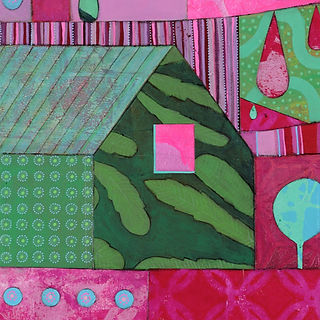
Structures - Field Barns 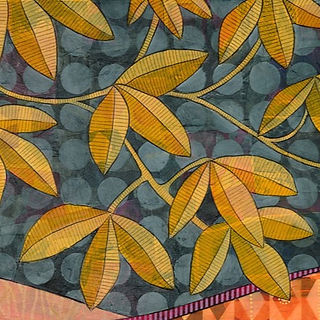
Foliage - Corkwood Tree 
Raindrops - Passage 
Pattern - Self
I did not plan these symbolic motifs before beginning this body of work, they emerged through explorations in oil pastel and printmaking, visual reflections and en plein air drawings in the landscape. They settled in my mind as being relevant and important, and then they kept surfacing, and eventually I understood that my job was not to resist them but to ask what they were trying to say. And to explore ways of expressing and describing these elements in the evolving body of work.
This is what I mean by compulsion creating visual language. When something keeps returning in your work, it is not a glitch. It is the beginning of a vocabulary - your vocabulary, specific to you, emerging from something deeper than conscious decision-making.
The question is not 'why do I keep painting this?'
The question is 'what is this trying to tell me that I haven't yet been able to fully understand?'
| Going Deeper, Not Moving On
There is a pressure in contemporary creative culture particularly with our constant exposure to social media, to always be making something new. A new series. A new style. A new direction. Novelty is rewarded. Consistency is sometimes mistaken for stagnation.
But the artists who have made the most enduring work are almost never the ones who ranged most widely. They are the ones who went most deeply in a more focused and singular way, who stayed with a question long enough for it to yield something real, personal and meaningful to them.
They were the artists who resisted the temptation to move on before the work was finished with them.
Depth takes time.

It takes the willingness to make work that doesn't immediately announce itself as new or different. It takes trust in the process, in the compulsion, in the idea that sustained return will eventually reveal something that a single visit or handful of visits never could.
This does not mean making the same painting indefinitely. It means allowing a body of work to develop its own internal logic, its own recurring questions, its own vocabulary.
And then following that, wherever it leads, even when the destination is not yet visible.
And it's at this point where stories of personal relevance and importance can really start to emerge and shape the work into something unique.
You can explore the paintings and read more about my Threshold Series here.