Colour Theory: Prismatic Colour
If you've been following my Instagram you'll know I've been taking a bit of a deep dive into colour theory recently. I am a self confessed colour addict and it's always been a fundamental part of my visual language.

But more often than not, I've worked with it intuitively or subconsciously rather than intentionally and consciously.
I was interested to test my knowledge and understanding and see where making more conscious decisions about colour theory might take me.
So I launched into David Hornung's 'Colour Workshop for Artists and Designers' for assistance.
What a wonderful book, it took me a few days to get my head around some of the language and meanings but once I did, I was all in, completely hooked.
I'll be creating a new blog post for various aspects of my 'colour journey'. But if you want to go all in right now, you'll find the details of the book at the end of this post.
| Abandoning Initial Instructions!
So to start with, I confess I immediately abandoned all the instructions in the book about cutting up swatches neatly into regimented squares so everything would fit perfectly in the recommended binder, as all that felt like a lot of time spent on fiddly tasks which didn't change the learning outcome, though I appreciate it would have all looked totally perfect and made a wonderful show-and-tell!
Instead I opted to fill sketchbook pages with all the exercises, to which I could add my scrawled and scribbled notes as I went.
I did use the recommended gouache paints on bleed-proof marker paper in order to make the colour swatches as 'flat' as possible. I labelled and batched them to begin with as I found myself swimming in a sea of colour and trying to remember the colour recipe for each swatch was a challenge!

| Prismatic Colour
Understanding prismatic colour theory was the first stop. Using red, yellow and blue on both the cool and warm spectrum and intermixing them in different ways, created really fascinating differences. I'd never really though about these primary colours being particularly warm or cool - I'd always though more of red and yellow as being warm and blue as being cool - but clearly there's more to it!


| Chromatic Darks
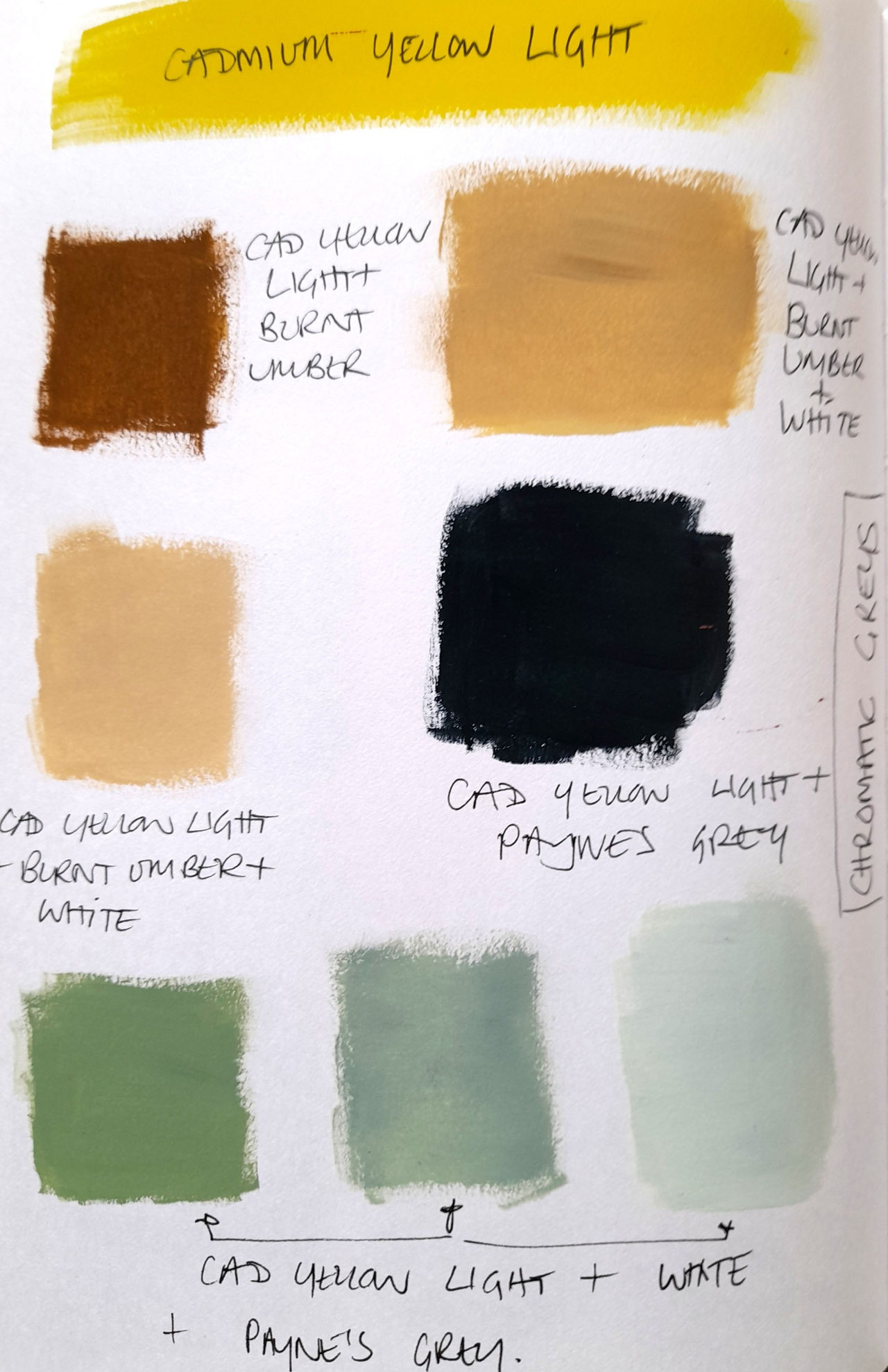
Moving on to understanding which colours to use to make different types of dark colours using 'admixtures'. Using a cool admixture (Payne's Grey) and a warm admixture (Burnt Umber) produced striking differences when added to prismatic colours. I'd never used Burnt Umber in this way. In fact I have a pot sitting on my bench that has been untouched, probably for years now!
| Muted Colour
Muting colours by cross mixing warm and cool prismatics enables you to maintain saturation value without working with pure, prismatic bright colour, which even for me can sometimes be a bit too much! I have a bit of a fear of wish washy colours which in the past I've steered clear of as the only way I understood how to de-saturate was to add white or black (making tints and shades on the grey scale). These admixture concepts are a revelation, as I can now maintain saturation levels in my colours without over-powering brightness.

| Tints & Shades
This was a fun exercise, it was a bit like wringing out a wet towel - just how much more can you squeeze out of a handful of colours! Sometimes my brain just stops two or three tweaks into using one colour, but when you play around with just a single colour and keep going with mixing a whole range of warm and cool greys based on muted and prismatic colour, you could really go on forever, though I confined myself to just a page of each....


| Colour Studies
The rich visual quality achieved by combining greys in different values with saturated and muted colours is lovely. I’ll explore this more. I’ve been enjoying a deeper dive into greys of various kinds, they act as a kind of invaluable supporting actor, steeped in subtlety and calm. I'll be looking at ways I can explore single base colours in this way in future sketches and paintings.


'Colour Third Edition: A workshop for artists, designers' by David Hornung 2020